Shipwreck coins
A coin that spent three centuries on the seabed carries something an ordinary coin cannot: a proven story. That story is most of the price.
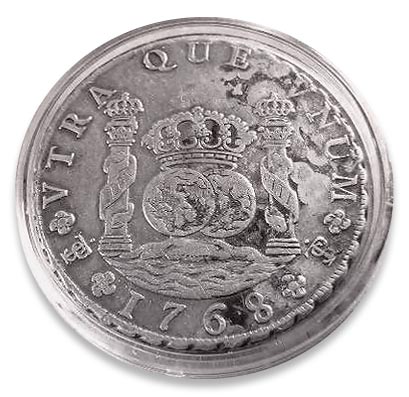
An ordinary old coin is worth its metal, its rarity, and its condition. A shipwreck coin adds a fourth thing that none of those can supply: a proven history. It was on a specific ship, on a specific voyage, that sank on a specific day, and someone brought it back up. That documented past is why two coins of the same denomination and metal can sell for prices that are worlds apart. This page explains how the sea marks a coin, why provenance is worth so much, and how to buy without getting burned.
Where they come from
The great shipwreck coins are Spanish, because Spain shipped the world’s silver and gold across the ocean for three centuries and lost some of it along the way. The treasure fleets carried pieces of eight and gold doubloons, mostly as hand-struck cobs, and when a fleet went down, that cargo went with it. The 1715 Treasure Fleet off Florida and the Nuestra Senora de Atocha off the Keys are the two names every collector knows, and between them they have returned coins by the thousand.
What the sea does to a coin
Time underwater leaves a mark. Silver that sits in seawater for centuries can come up etched, frosted, or darkly toned, and coins packed together in a chest sometimes fuse or take on the impression of their neighbors. Iron from a wreck can stain nearby silver. None of this is damage in the collector’s sense; it is the evidence of where the coin has been. Conservators clean recovered coins with care to stabilize them without erasing that evidence.
This is exactly why a sea-found coin should never be scrubbed by an amateur. Harsh cleaning strips the surface, removes the honest look of a salvaged coin, and can cut its value sharply. If you pull a coin from a Florida beach, the right move is to leave it as found and get advice, which our guide to a coin found on a Florida beach covers in full.
Why provenance is the price
Here is the heart of it. A raw, ungraded 8 reales with no story might sell for a few hundred dollars. The same coin, recovered from the 1715 Fleet, conserved, sealed in a grading holder, and sold with a salvage certificate, often asks several thousand. Little of that difference is the silver. Almost all of it is the provenance, the paperwork and the named wreck that turn a piece of old money into a documented artifact of a famous event.
That premium is real and, for many buyers, worth paying, because the story is the point. But it means you have to know what you are buying. A shipwreck coin without documentation is just a coin with a claim, and the claim is what carries the value. Our coin values page lays out the ranges with this gap made plain.
Buying safely
Treat a shipwreck coin as a purchase of provenance, and check the provenance the way you would check a title. Look for a salvage certificate from the company that worked the wreck, ideally a coin already in a recognized third-party grading holder that notes the shipwreck, and a seller with a track record you can verify. Be suspicious of a bargain: a genuine, certified 1715-Fleet or Atocha coin does not sell cheap, so a low price on one is a reason to slow down, not to hurry. Confirm that any certificate is authentic and matches the coin. Bought with care, a shipwreck coin is one of the few collectibles that comes with its own true adventure story attached.
Sources
Frequently asked questions
What are shipwreck coins?
Shipwreck coins are coins recovered from a sunken ship, most famously the Spanish silver cobs and gold escudos carried by treasure fleets. When a fleet sank, its coins went to the seabed, and salvage brings them back, often with documentation tying each coin to a named wreck.
Why are shipwreck coins worth more?
The value is in the provenance. A coin linked to a named wreck like the 1715 Fleet or the Atocha, sold with a salvage certificate, carries a large premium over the same coin with no history. Buyers pay for the documented story as much as for the silver.
Does seawater damage the coins?
It can. Long immersion can etch, tone, or corrode a coin's surface, and silver sometimes comes up with a frosted or darkened look. Conservators clean recovered coins carefully. Harsh cleaning by an amateur can lower value, which is why sea-found coins should be left to specialists.
How do I buy shipwreck coins safely?
Buy provenance, not just a coin. Look for a salvage certificate, a recognized grading holder, and a reputable seller who can document the wreck. Be wary of a low price on a supposedly certified shipwreck coin, and confirm the certificate is genuine before you pay.