How to identify a Spanish colonial coin
A Spanish colonial coin carries its own name tag. Read four things, the mint mark, the assayer, the denomination, and the date, and you can say what it is and roughly when it was struck.
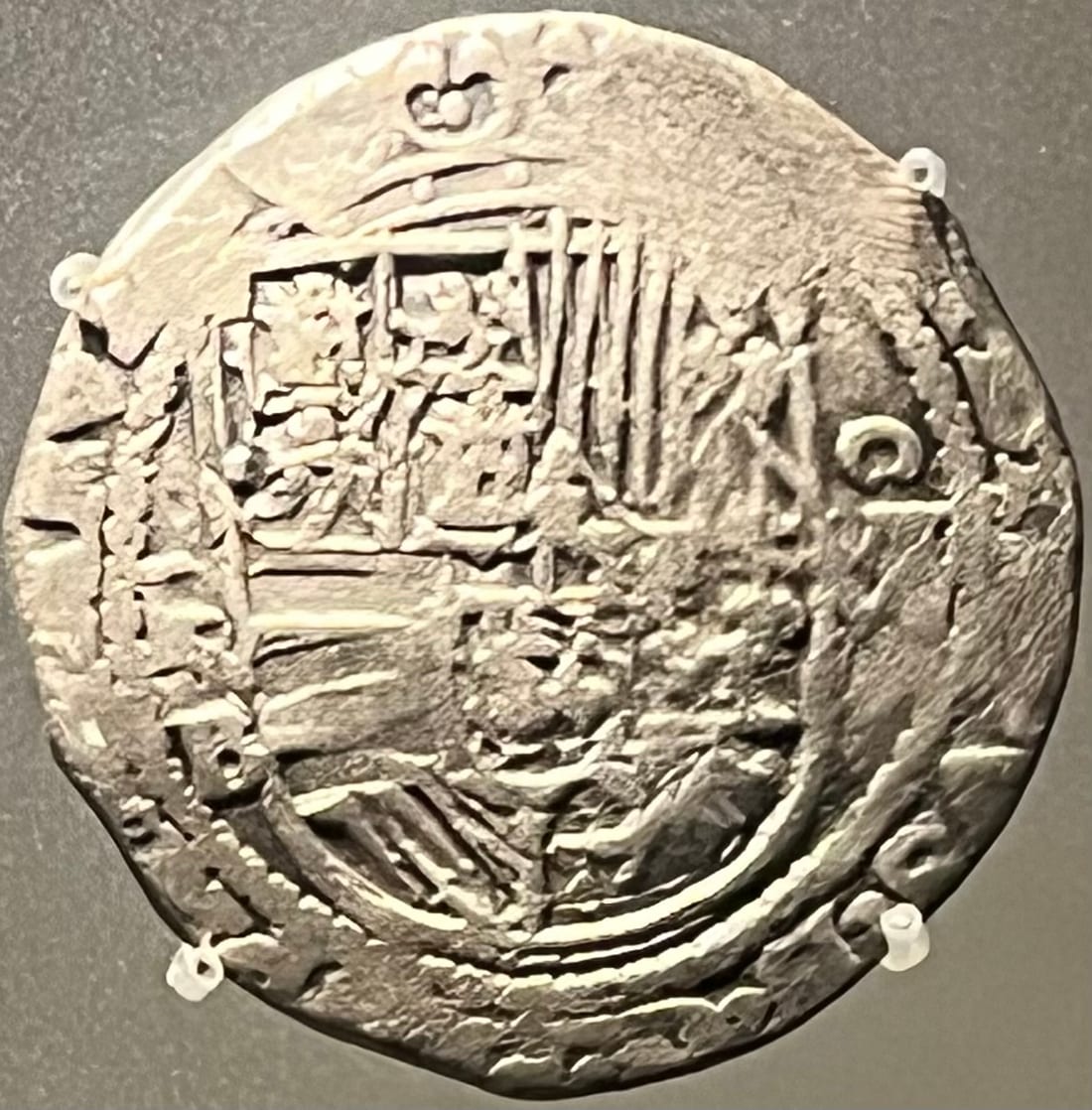
Read the coin in four steps
Turn the coin to the shield side. On a cob, the layout is consistent once you know it. The mint and assayer marks stand to one side of the crowned shield, the denomination to the other, and a date runs nearby. Work through these in order.
| Read | Where to look | What it tells you |
|---|---|---|
| Mint mark | Left of the crowned shield | A letter or monogram that names the mint, such as oMo for Mexico City or the PTSI monogram for Potosi. |
| Assayer initial | Beside the mint mark | The initial of the assayer who certified the silver. It helps pin down the year and workshop. |
| Denomination | Right of the shield | A numeral, 1/2, 1, 2, 4, or 8, giving the value in reales. |
| Date | Often three digits on cobs | Many cobs show only part of the date because the flan was clipped to weight. A partial date still narrows the era. |
Mint marks by city
The mint mark is the single most useful stamp on the coin. It names the city that struck it. The table below covers the mints you are most likely to meet on a coin from the Florida wrecks and the wider Caribbean trade.
| Mint | Mark | Region | Notes |
|---|---|---|---|
| Mexico City | M, oMo | New Spain (Mexico) | The busiest colonial mint. The oMo monogram reads 'o-M-o'. |
| Potosi | P, PTSI | Upper Peru (Bolivia) | Silver from the Cerro Rico. The PTSI monogram stacks the letters and looks like a dollar sign. |
| Lima | L, LM, LIMA | Peru | Marks change by era: a single letter, a monogram, or the full city name. |
| Santo Domingo | S, SP | Hispaniola | One of the earliest American mints; its coins are scarce. |
| Bogota | NR | Nuevo Reino (Colombia) | NR stands for 'Nuevo Reino'. Mainly a gold mint. |
| Cartagena | C | Nuevo Reino (Colombia) | Another New Granada mint that struck gold escudos. |
Cob or milled?
Two looks tell you when and how a coin was made. A cob is irregular, thick, and hand-struck, the norm from about 1572 to 1773. A milled coin is round and even, made by machine. The milled 8 reales, the columnario or pillar dollar, arrived in 1732 and shows two globes between the Pillars of Hercules with the motto PLUS ULTRA over waves. If your coin is a neat circle with two pillars, it is a pillar dollar; if it is a rough lump with a shield, it is a cob. Our page on what a cob coin is covers how the rough ones were made.
Real or replica?
Replicas and modern fantasy pieces are everywhere, and many are sold honestly as souvenirs before changing hands as the real thing. Weight and size are the first check: an 8 reales should be near 27 grams of silver and about 38 to 40 millimeters across. A magnet is a quick test, since real coins are silver or gold and are not magnetic. Crisp, identical detail on a supposedly hand-struck cob is a warning sign, as is a coin that looks cast rather than struck. When money is on the line, a coin worth authenticating is worth sending to a recognized grading service. Our guide to a coin found on a Florida beach has more on telling real from fake.
Sources
Frequently asked questions
Where is the mint mark on a Spanish colonial coin?
On most cobs the mint mark sits to the left of the crowned shield, with the assayer initial beside it and the denomination to the right. Mexico City used oMo and Potosi used a PTSI monogram that looks like a dollar sign.
What does the assayer initial tell you?
The assayer was the official who certified the silver or gold content. The initial next to the mint mark identifies that person, which helps pin the coin to a mint, a workshop, and a narrow band of years.
Why do cobs have only part of a date?
Cobs were clipped to the correct weight after striking, so the trimming often removed part of the design, including some of the date. A partial date still narrows the era, and the coin type does the rest.
What is a pillar dollar or columnario?
A columnario is a milled 8 reales made from 1732 onward. It shows two globes between the Pillars of Hercules, with the motto PLUS ULTRA over waves. It replaced the rough cob look with a round, even coin.