What is a cob coin?
Before machines, Spain's American mints made money by hand: cut a blank, hammer it, clip it to weight. The result was the cob, rough and unmistakable.
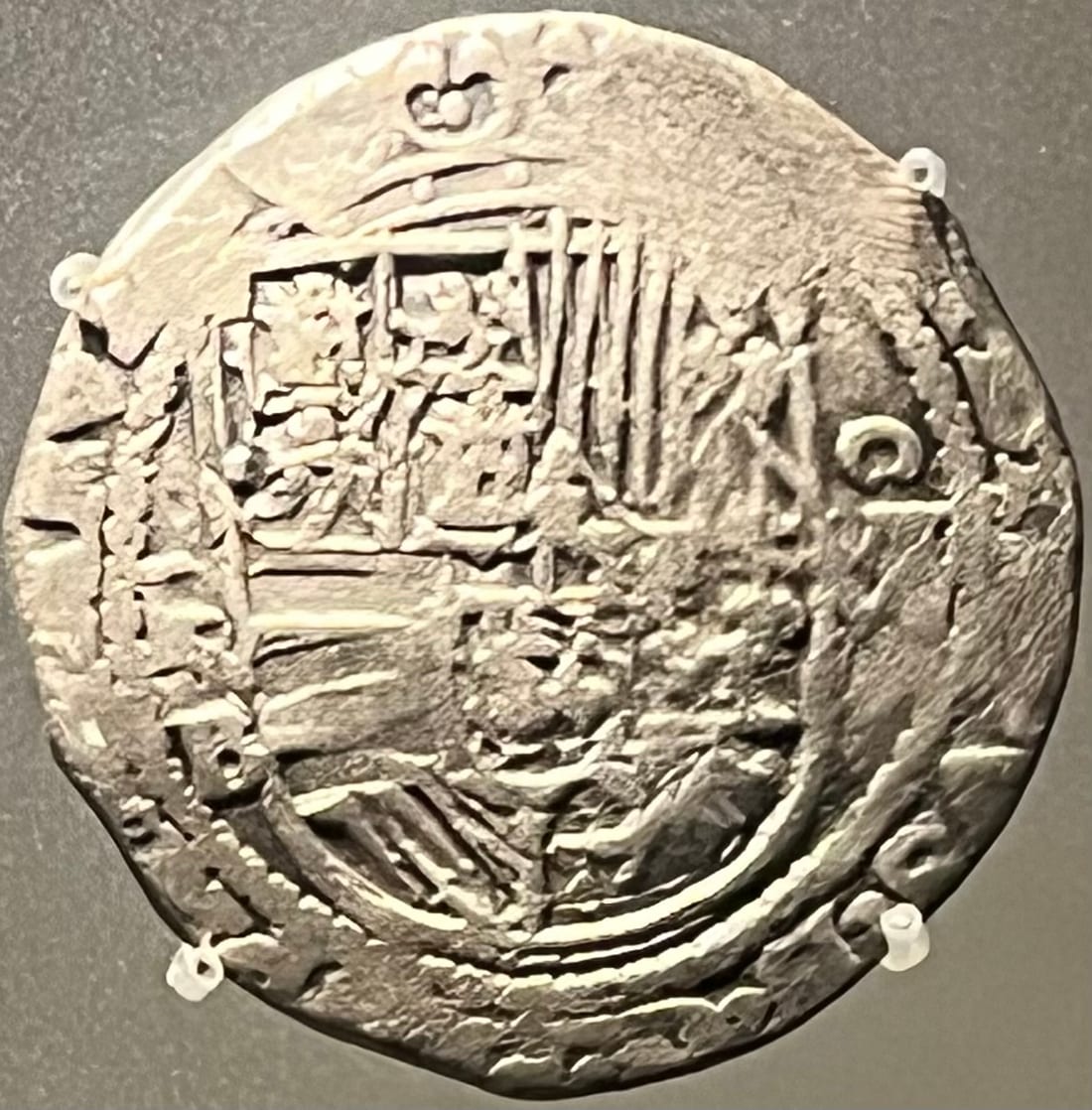
Pick up a Spanish cob for the first time and your instinct is that something went wrong at the mint. The coin is lumpy, off-center, and often missing part of its design at the edge. Nothing went wrong. That rough shape is exactly what a colonial mint was trying to produce, because the one thing that had to be perfect was the weight of the silver. This page explains how cobs were made, why they look the way they do, and how to read one.
Made by hand, cut to weight
The word cob most likely comes from the Spanish cabo de barra, “end of the bar”, and that phrase describes the process. A mint worker started with a cast bar of silver or gold of certified purity. From the end of that bar, a blank was cut. The blank was then struck between two hand-engraved dies, one for each face, with a hammer blow that pressed the design into the metal. Finally the coin was clipped with shears until it hit the exact legal weight for its denomination.
That last step is why cobs look the way they do. The mint did not care whether the coin was round or whether the whole design fit on the flan. It cared that an 8 reales held the right weight of silver. So workers trimmed each piece to weight, and the trimming carried away part of the rim, part of the shield, sometimes part of the date. A cob is a coin made to a standard of mass, not of beauty.
What a cob looks like
Cobs are thick and irregular, with a design that rarely sits centered. The silver ones ran in the usual reales ladder, from a half real up to the 8 reales, the piece of eight. Gold cobs ran in escudos. The early types show a crowned Habsburg shield on one side. Later cobs, into the 1700s, include the pillars-and-waves design, with the twin Pillars of Hercules over stylized sea. Whatever the type, the surface tells you it was hammered by hand, with uneven relief and honest, slightly crude lettering.
This is the norm for Spanish silver from about 1572 to 1773. Round, even coins made by machine, the milled coinage, began to appear from 1732, and for a while both were made. If your coin is a neat circle with sharp, regular detail, it is milled, not a cob. If it is a rough lump with a shield or pillars, you are holding a cob.
Reading a cob
Because part of a cob is usually missing, identification is a matter of reading what survives. The layout is consistent. To one side of the crowned shield sits the mint mark, a letter or monogram naming the city, with the assayer’s initial beside it. To the other side is the denomination. A date may run nearby, often incomplete. Mexico City marked its coins oMo, Potosi used a monogram that resembles a dollar sign, and other mints had their own stamps. Our full walkthrough is on how to identify a Spanish colonial coin, and the glossary defines the terms.
Even a partial date is useful. Combined with the mint mark, the assayer, and the coin type, it can place a cob within a narrow band of years. Serious collectors prize a cob with a full, clear strike and a legible date precisely because so many came out incomplete.
Why so many survive from the sea
A great many of the cobs on the market today were recovered from shipwrecks, and there is a reason. Cobs were the coin of the treasure-fleet era, so when a fleet sank, its cargo was cob silver and gold. The 1715 Treasure Fleet off Florida and the Atocha off the Keys both went down carrying cobs, and salvage has returned them by the thousand. A cob from a named wreck, with a salvage certificate, carries a premium that has little to do with the metal and everything to do with the history, as our page on shipwreck coins explains.
So the humble, lopsided cob is not a mistake or a lesser coin. It is money made the old way, weighed rather than polished, and it is the very form in which most Spanish treasure went to the bottom of the sea and, sometimes, came back.
Sources
Frequently asked questions
What is a cob coin?
A cob is a Spanish colonial coin made by hand between about 1572 and 1773. A blank was cut from a cast silver or gold bar, struck between hand dies, and clipped to the correct weight, which left a thick, irregular coin. The name likely comes from the Spanish phrase cabo de barra, meaning 'end of the bar'.
Why do cob coins look so rough?
Because weight mattered more than looks. The mint's job was to produce coins of exact silver content, not pretty ones. Workers clipped each blank to weight, so the shape came out uneven and part of the design often fell off the edge. A rough, off-center coin is normal for a cob.
When were cob coins made?
Roughly from 1572 to 1773. Milled, machine-made coinage began appearing from 1732, and the two overlapped for a time before machines took over. So a cob is a good sign of an earlier colonial date.
How do you read a cob coin?
Look for the mint mark and assayer initial to one side of the crowned shield, the denomination to the other, and any surviving date nearby. Because cobs were clipped, part of the design is often missing, so identification leans on the marks that remain and the coin type.
Are cob coins worth money?
They range widely. A common raw cob can be modest, while a well-struck cob from a named shipwreck with a certificate sells for thousands. Provenance and strike quality matter more than the fact that it is a cob.